Brew It Yourself.
We Have Everything You Need!
Our retail location is in New York, and we have an online shop. We sell supplies for making beer, wine, and cheese. Come visit us in Rensselaer, NY. We cater to all levels of brewing, from Master Brewers to First Timers.
Questions?
Visit us on Facebook: Homebrew Emporium Facebook
518 283 7094
Hop Rhizomes are now in stock and ready to plant!
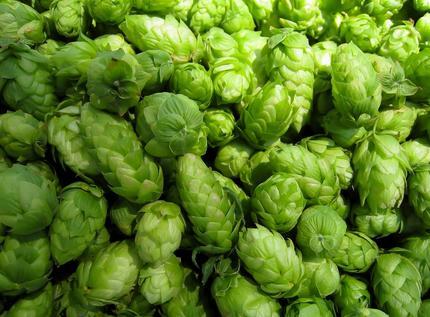
Hop Rhizomes are perennial, ornamental, have a great aroma and you can use your homegrown hops to brew beer with. They’re very easy to plant and just need a sunny spot with well drained soil and plenty of water to plant them. You can plant them next to a fence, a tree, a trellis, anything that a hop vine (actually called a bine) can climb. Get them now while they’re available, planting time is here!
They are $6 each and buy five get one free. We will provide planting instructions for you if you need them.
The following is a list of available hop rhizomes that you may purchase:
Cascade
New Zealand Alpha Aroma aka Rakau
Triple Pearl
Columbus
Nugget
Hallertau
Kent Golding
Chinook
Check out the full list of hop rhizomes on our Blog here:
________________________________________
Questions?
You can contact us with your order or with questions by phone, email or in person at:
Homebrew Emporium
472 North Greenbush Road
Rensselaer, NY 12144
518-283-7094
heny@beerbrew.com
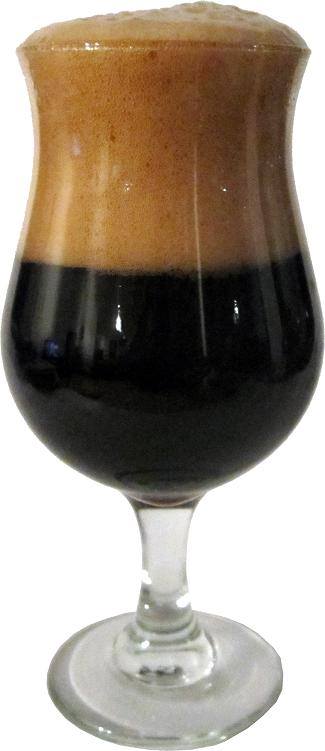
Here’s a great Irish Stout recipe to take the winter time chills away!
This is an extract version of a stout recipe that you can brew indoors, which will warm your house up at the same time! This is a tried and true roasty smooth stout. This beer will be ready to drink by St. Patrick’s Day! We have copies of this recipe at the store, but here it is:
Brown Box Irish Stout Recipe
1) Sanitize your fermenter (either a carboy, stopper and blow-off tubing or plastic bucket, lid and airlock) by soaking for a minimum of 5 minutes in an Iodophor solution: 1/2 oz. (1 Tbs.) per 5 gallons water (a one step cleaner/sanitizer may be used instead).
1/3 pound Roasted barley 1/2 pound Crystal malt 1/3 pound Black malt
2) Add 1 1/2 – 2 1/2 gallons of cold water to your brew pot. Add the following milled grains to the water and heat.
Steep grains 10-15 minutes @ 155’F. Remove and rinse.
3) Bring brew pot to boil. Remove from heat. Add malt extract (and any other sugars and/or water treatments, but do not add your priming/bottling sugar). Stir until everything has dissolved. Return to heat.
1 ½ oz. Fuggles – 60 minutes
½ oz. Fuggles – 2 to 3 minutes
4) Boil above ingredients (wort) for a total of 1 hour. Add hops throughout the boil.
5) Turn off heat. In order to help cool down the wort, take your brew pot off the stove and cover it to avoid splashing. Immerse it in a sink partially filled with ice-water and swirl the pot occasionally. Chill until the bottom of the pot is cool to the touch when removed from the ice water bath.
6) Fill your sanitized fermenter with approximately 2 gallons of room temperature water. It is important that you add the water to the fermenter first when using a glass carboy since the glass can crack when subjected to extreme temperature changes.
7) Splash the wort into the fermenter while straining out the hop trub. Splashing will help dissolve some air into the wort. Top up to 5 gallons with room temperature water.
Immediately add (pitch) your yeast when the wort is at or below 78F (when the fermenter no longer feels warm to the touch).
Safale-04 English ale yeast or another English or Irish Ale yeast would work well for this.
If you’d like to use a liquid yeast, White Labs 004 or Wyeast 1084 are great choices.
9) If using a carboy, attach stopper and blow-off tubing and run the other end into water in a container to collect excess foam(blow-off).
Make sure stopper is dry so that it creates a firm seal in the neck of the carboy.
After blow-off has subsided (24-48 hours.) replace tubing with a sanitized airlock 1/2 full of water. If fermenting in a plastic bucket, attach lid and airlock 1/2 full of water.
10) Ferment in a dark place. Fermentation should start within 48 hours and finish within 3-10 days or up to 50 days at colder temperatures (Ale yeast is best used between 63F-75F. Lager yeast is best used at 42F-58F).
11) To be sure fermentation is complete siphon off enough beer to fill your hydrometer flask and float your hydrometer in it. A specific gravity of 1.018 or higher indicates incomplete fermentation. The beer is not safe to bottle. If the specific gravity is lower than 1.018, you’re ready to bottle and should do so within the next week.
12) Sanitize your siphon, bottles and bottling bucket as indicated in step #1 above. Be sure to sanitize your bottle caps!
13) Boil (priming sugar) in one pint of water for 5 minutes and splash into your bottling bucket.
3/4 cups corn (priming) sugar
14) Siphon beer from fermenter to bottling bucket. Avoid taking up yeast from fermenter and splashing beer in bottling bucket. Gently stir with the end of the siphon tube to mix in the priming sugar.
15) Fill bottles from spigot, leaving 1/2″ to 1″ airspace and cap.
16) Store bottles upright in dark place at fermentation temperature for at least two weeks.
17) Drink the beer. Repeat.
Original Gravity:
1.053
(1.047 to 1.055)
Terminal Gravity:
1.014
(1.012 to 1.015)
If you have any questions you can call us at 518-283-7094, see you soon!
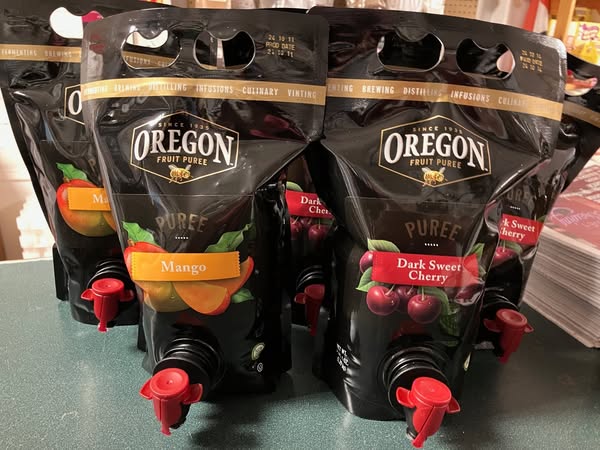
Want an easy way to add real fruit to your Cherry Wheat beer, Pineapple IPA or Mango Mead?
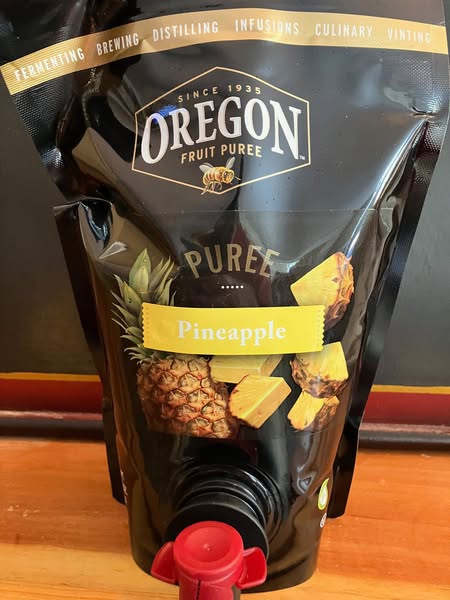
We are now carrying Oregon Fruit Purees. Currently we have Mango, Dark Sweet Cherry and Pineapple to choose from. The starting specific gravity of the purees is between 1.080 and 1.110
These are aseptic fruit purees, meaning they have been pasteurized and are free from contamination caused by harmful bacteria, viruses, or other microorganisms. These have been heat pasteurized and are free of any added chemicals.
They can be added right into the secondary or the primary straight from their package to give delicious fruit flavor to your beer, mead or wines, without having to worry about contaminating your beverage. 1 package will be great to add to your 5 gallon beverage.
You can also use one of these to make a gallon of fruit wine. We can supply you with a simple recipe to put this together. You can use one package to make 1 gallon of wine.
They are 49 oz each and $18.99 for Cherry, $19.99 for Mango, and $19.99 for Pineapple.